
Agentic Security Operations Series – Post 3 of 3
Bogota, Colombia — May 22, 2026
The shift from AI that assists to AI that executes is not an upgrade. It is a different operating model. This post covers what that model requires — and how Synergy Advisors can help you achieve it.
In our previous blog, The Operational Layer That Makes Security Copilot and AI Agents Work, we covered how Micro-Vigilant functions as the operational context layer that structures everything Security Copilot and agents depend on — clean signals, prioritized incidents, balanced workloads, continuous visibility.
This post is about what that foundation enables. Specifically: the move from Copilot as an assistant to agents as operational participants — what that transition requires, where most organizations are not yet ready for it, and how Synergy Advisors can help.
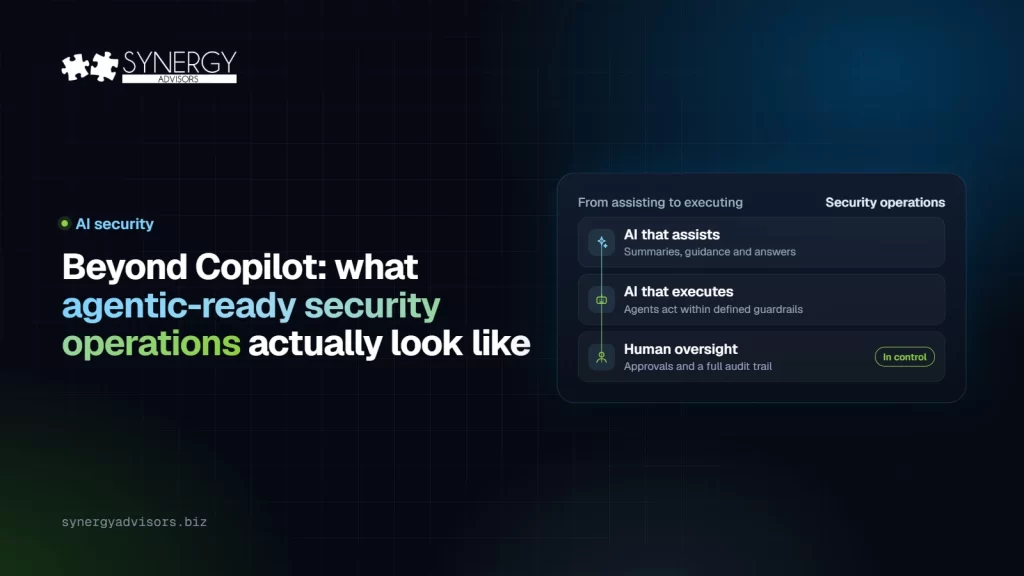
The difference between assistance and execution
Security Copilot operates on demand. It answers when asked, surfaces context when invoked, and produces outputs that an analyst then interprets and acts on. At every step, a human is in the loop — reading the output, making the decision, initiating the response.
Agents operate differently. They monitor conditions continuously, detect triggers, and execute actions — across systems, without waiting to be prompted. An agent does not surface a recommendation that a human then carries out. It carries it out directly, within the scope it has been given, at the speed of automation.
That shift changes everything about how these capabilities need to be designed, deployed, and governed. An agent acting on incorrect context does not produce a wrong recommendation. It takes a wrong action. The consequence is not a bad output — it is an incorrect response in a live security environment.
This is why reaching agentic-ready operations is a distinct challenge, separate from and beyond what Copilot adoption requires. And it is why Synergy Advisors has built its capabilities and delivery model specifically around it.
What Synergy Advisors being Agentic-Ready means
Agentic-ready is not a roadmap commitment or an aspiration. It is a description of how Synergy Advisors operates today — the methodology, the technical architecture, and the managed service model that enable us to take organizations from their current state to one where agents are a safe, effective, and governed part of operations.
Being agentic-ready means we have solved, in practice, the problems that make agent deployment difficult::
- We know how to identify the operational scenarios where agents deliver real value in a your environment — and the ones where they are not yet ready to operate without human supervision.
- We know how to build agents that are operationally sound, not just technically functional — agents that map to real problems, integrate with real workflows, and are scoped to what they can reliably handle.
- We know how to manage agents as the identities they are inside Microsoft Entra — with the governance, access controls, and lifecycle management that prevent agents from becoming a risk.
- We know how to establish visibility into AI operating in an organization — including the AI that was never officially deployed — so that governance covers the full picture, not just the official one.
Each of these capabilities translates directly into what organizations need to make this transition safely. The following sections describe each of the above bullets in detail.
Building agents around operational problems, not technical possibilities
The most consistent failure mode in enterprise agent deployment is beginning with the technology. Organizations stand up an agent framework, connect it to APIs, and then work backward to find a problem it can solve. The result is technically functional and operationally irrelevant — an agent that works in a demo and does nothing useful in production.
The correct starting point is the operational problem. Specifically: which high-frequency, high-cost tasks in your operations follow a well-defined enough pattern that a well-built agent can handle reliably — freeing your knowledge workers to focus on the tasks that genuinely requires judgment?
For example, in the Microsoft security ecosystem, the highest-value starting points are consistent:
- Alert triage and enrichment. Automatically assembling context from Defender, Entra, and M365 for every incoming alert — so analysts open incidents with the relevant information already in place, rather than spending the first part of every investigation gathering it manually from multiple sources.
- Incident correlation. Cross-referencing new incidents against historical patterns, known threat behaviors, and existing open investigations — surfacing connections that would require significant analyst time to identify manually, at the moment they are most relevant.
- Containment initiation. For well-defined threat scenarios with established response playbooks, triggering containment actions automatically — endpoint isolation, account disablement, indicator blocking — within defined scope and approval thresholds, without requiring manual coordination.
- Security operations continuity. Extending the visibility and health monitoring that Micro-Vigilant provides — workload imbalances, aging incidents, detection quality issues — with automated remediation actions that close gaps without waiting for a human to notice them first.
Synergy Advisors works with organizations to define these use cases against the specific realities of their environment and their team — and then builds the agents that execute them. The deliverable is not a generic agent capability. It is a specific set of production-grade agents solving specific problems that exist in your operations today.
Managing agents as identities: the Entra architecture
Here is the problem most organizations discover too late: an agent is not just software running in your environment. Inside Microsoft Entra, it is an identity — one with permissions, with access to sensitive systems, and with the ability to take actions across your environment.
An agent connected to Defender APIs, Entra data, and M365 signals is a privileged identity. If that identity is not managed with the same rigor applied to privileged human accounts, it becomes a vulnerability — not just an operational risk, but a security one.
Synergy Advisors builds the Entra identity architecture for every agent deployment:
- Workload identity registration. Every agent is registered in Entra as a workload identity with explicitly scoped permissions — access to the specific capabilities required to function, and nothing beyond that. Overprivileged agents are a lateral movement risk in any environment where compromise is possible.
- Conditional access policies. Agents operate under defined conditions — approved scopes, behavior monitoring, operational parameters — governed by the same Conditional Access framework applied to human identities in the environment.
- Lifecycle management. Agent permissions are reviewed on the same cycle as human identities. When an agent’s scope changes, its permissions are updated immediately. When an agent is decommissioned, its identity and all associated access are fully removed — not left dormant in a state that creates future risk.
- Full audit trail. Every action an agent takes is logged against its identity, creating a complete, auditable record of what it did, when, and under what conditions. This is how you validate that the agent is doing what it was designed to do — and how you catch it when it is not.
Agent identity management is not optional governance work that can come later. It is part of what makes agent deployment safe from the first day of operation.

Governing AI you did not deploy: visibility through MDCA
There is a challenge that is invisible in most organizations until it becomes urgent. By the time a security team is ready to deploy official AI agents, the broader organization has almost certainly already been using AI — tools that were never procured through IT, never evaluated for security, and never brought to the attention of anyone responsible for data governance.
This is shadow AI. And in an enterprise Microsoft environment, the tool built to address it systematically is Microsoft Defender for Cloud Apps (MDCA).
MDCA gives security teams the visibility and control they need to govern AI across the full scope of what is actually operating in the organization:
- AI application discovery. Which tools are being used, by whom, at what volume, and with what organizational data — including applications that were never officially approved. The picture MDCA produces is often significantly broader than security teams expect.
- Risk assessment by application. Not all shadow AI carries the same risk profile. MDCA provides risk scoring and classification that enables informed, specific decisions — block this, sanction this, bring this under governance — rather than applying blunt policy to a problem that cannot be seen clearly.
- Data flow enforcement. Sensitive organizational data — classified documents, customer records, confidential communications — can be prevented from reaching external AI services that do not meet the organization’s data handling standards. This is enforceable policy, not guidance.
- Governance baseline. The discovery data MDCA produces becomes the foundation of the organization’s AI governance framework. Governing AI starts with knowing what AI is operating. Most organizations, without MDCA, do not have that picture
Deploying official agents into an environment without this visibility means operating alongside unknown AI with unknown access to organizational data. Synergy Advisors integrates MDCA discovery and governance into every agentic readiness engagement — so by the time agents are deployed, the full AI landscape is governed, not just the official part of it.
The Synergy Advisors agentic-ready engagement
What Synergy Advisors delivers is not a deployment. It is a complete operational transition — from where your operations teams are today to one where agents are a secure, governed, and measurable part of how it runs.
- Use case definition. Identifying the specific problems in your environment where agents will deliver real operational value — with an honest assessment of where human judgment remains the right answer and autonomous execution is not yet appropriate.
- Agent design and implementation. Building production-grade agents against the Microsoft security stack, integrated with the Micro-Vigilant operational context layer, scoped precisely to the scenarios that matter for your team and your environment.
- Entra identity architecture. Every agent deployed as a governed identity from day one — scoped permissions, conditional access policies, and full lifecycle management from deployment through decommission.
- MDCA visibility and governance. AI discovery, risk assessment, and data flow policy in place before official agents go live — so the organization has a complete, governed picture of its AI landscape from the moment agents become part of operations.
- Continuous monitoring through Micro-Vigilant. Ongoing visibility into agent performance, security operations health, and operational impact over time — ensuring that what was deployed continues to work as intended, and that the team has the data to keep improving it.
The result is an organization that has not just deployed agents — it has built the complete operational, identity, and governance infrastructure that makes agents sustainable. That is what agentic-ready means. And it is what Synergy Advisors is already built to deliver.
This series has followed a single arc: from activating Security Copilot, to building the operational context layer with Micro-Vigilant, to deploying agents with the identity governance and visibility that make them safe and effective. If any of these posts describe a gap that exists in your organization today, the right next step is a direct conversation about what closing it looks like in your specific environment.
Ready to move beyond Copilot and build agentic-ready operations?
The organizations that lead over the next several years will not be the ones with the most AI tools. They will be the ones that built the operational model to use those tools well. Becoming agentic-ready is a structured transition — it starts with an honest assessment of where your operations stand today across Copilot adoption, operational context, identity governance, and AI visibility, and builds toward a governed, measurable execution model.
Synergy Advisors is working with a select number of organizations on exactly this engagement. If you are ready to move beyond Copilot and build operations that can operate at the pace the current environment demands:
Governing the AI agents your teams are already building? Explore our Agent 365 E-xperiences, a guided path from the first conversation to governed agents in production.