
Agentic Security Operations Series – Post 2 of 3
Bogota, Colombia — May 20, 2026
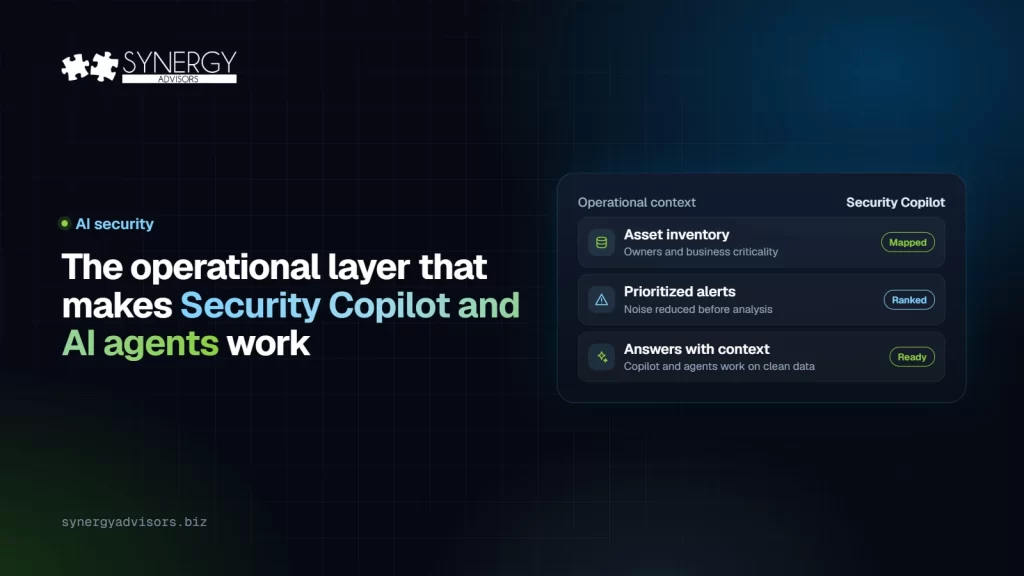
Security Copilot’s performance is directly tied to the quality of the operational context it works with. In most environments, that context is fragmented, unstructured, and unprioritized. This post is about the layer that changes that — and why it matters for everything that comes after.
In our previous blog, From Access to Adoption: Closing the Security Copilot Gap in Microsoft E5 Environments, we covered why Security Copilot consistently underperforms in organizations that have it — not because of the platform itself, but because of what it is being asked to work with. Fragmented signals. Inconsistent incident handling. No defined workflow for when or how to use it.
This post is about the layer that solves the underlying problem. Not Copilot configuration — the operational foundation that Copilot, your analysts, and eventually your agents all depend on.
The problem that sits below Copilot
There is a version of the Security Copilot performance conversation that focuses entirely on the platform: better prompts, more integrations, updated configurations. These things matter at the margin. They do not address the structural issue.
Security Copilot is an intelligence layer. It reasons over operational context. The quality of what it produces is a direct function of the quality of what it receives. And in most enterprise security environments, the operational context it receives is in poor condition — not because of negligence, but because no one has built the layer responsible for structuring it.
Here is what that looks like in practice. Incidents arrive across Microsoft Defender XDR workloads — endpoint, identity, email, cloud — without a unified view of what is open, what is critical, what is aging, and what is blocked. Analyst assignments happen informally, creating workload imbalances that produce coverage gaps invisible to managers. Alert fatigue builds as noisy detections compete for attention alongside real threats. Investigation context is assembled manually by each analyst, from multiple consoles, every time.
Security Copilot does not fix this. It inherits it. When it reasons over a disorganized operational environment, the outputs it produces reflect that disorganization — and analysts, learning quickly that the tool is only as reliable as what feeds it, stop trusting it.
The fix is not a Copilot setting. It is a dedicated operational layer between your Microsoft security infrastructure and the people and AI that depend on it.
What Micro-Vigilant is — precisely
Micro-Vigilant is not a product layered on top of your stack. It is not a SIEM. It does not replace Microsoft Defender, Sentinel, or any component of the Microsoft security platform.
Micro-Vigilant is a cybersecurity operations solution built to centralize, prioritize, and execute incident management from within the Microsoft security ecosystem. It is the operational context layer that structures what flows from your infrastructure to your analysts, to Security Copilot, and to the agents that come after both.
In practice, it does five things:
- Centralizes incident signals. Incidents and alerts from across Defender XDR — endpoint, identity, email, cloud — are pulled into a single, unified operational view. Platform-hopping stops. Fragmented context stops. The full picture is visible in one place.
- Prioritizes by impact and criticality. Alert volume is cut through. Cut through alert volume. Micro-Vigilant organizes open, aging, and blocked incidents and surfaces them based on what actually requires attention — before the team starts their day, not after they have already spent hours triaging noise.
- Distributes work with real visibility. Analyst workload, incident ownership, and progress are visible to both managers and analysts in real time. Critical telemetry enables managers to make assignments intelligently, based on capacity and criticality. Uncover gaps before they become missed threats
- Enables response execution directly. Analysts can enable response actions from within the operational flow, without requiring them to navigate between multiple Defender consoles or leave the environment they are working in to take action.
- Runs inside Microsoft Teams. The complete incident management lifecycle — triage, investigation, coordination, response — happens inside Microsoft Teams. Not in a new tool. Not in a new interface. In the collaboration environment your security team already works every day.
That last point carries more operational weight than it might initially appear. The context-switching cost in security operations — every time an analyst leaves their working environment to check a tool, run a query, or coordinate a response — is significant and almost entirely invisible in most organizations. Micro-Vigilant eliminates that friction by keeping everything where the team already is.
The Micro-Vigilant SecOps Agent: continuous operational intelligence
Micro-Vigilant includes an operational intelligence agent built specifically for Microsoft Defender XDR. It runs continuously — not when someone pulls a report or checks a dashboard, but at all times — analyzing incident handling, analyst workload, and response performance to surface what needs attention before it escalates.
What the SecOps Agent monitors and acts on:
- Security operations health. Stale, aging, and unassigned Defender incidents are surfaced automatically. Bottlenecks and assignment gaps are identified and flagged before they become missed threats or escalation failures.
- Analyst workload and performance. Incident distribution, mean time to respond per analyst, and workload imbalances are tracked in real time — giving managers the visibility they need to rebalance proactively, and giving analysts clarity about what they own.
- Critical incident visibility. The highest-severity unresolved incidents are flagged with specific blockers identified — not just that they are open, but precisely why they remain open and what is required to move them forward.
- Detection quality analysis. False positive rates and noisy detection rules across Defender workloads are analyzed continuously. Alert fatigue stops being a vague operational complaint and becomes a specific, addressable problem with identifiable sources.
- Actionable recommendations. Incident reassignments, workload rebalancing, and response prioritization are recommended based on live operational data — with insights calibrated separately for managers and individual analysts.
- Defender XDR signal awareness. Top alert categories and event trends are summarized and correlated with operational impact — so the team understands not just what is happening in the environment, but what it means for their workload, their coverage, and their risk posture.
This is what genuine operational visibility looks like — not a weekly dashboard review, but a continuous, structured picture of how security operations is actually performing, updated in real time, with specific recommendations for how to improve it.
How this transforms Security Copilot performance
When Micro-Vigilant is operating as the context layer, Security Copilot works with an entirely different environment. Incidents are structured and prioritized before Copilot engages with them. Context is enriched at the point of triage. Noisy detections are identified and filtered before they reach the analyst queue. Workload is balanced so that investigations receive the attention they require.
The outputs Copilot produces over a Micro-Vigilant-structured environment are more accurate, more specific, and more actionable — because they reflect an operational picture that has already been organized rather than one still in the process of sorting itself out.
For the organizations we work with, the change in Copilot performance after deploying Micro-Vigilant is not incremental. It is categorical. The tool moves from something analysts interact with occasionally to a core component of how every investigation is run.
The foundation that agents require
Micro-Vigilant does something beyond improving Copilot performance. It creates the operational foundation that makes deploying AI agents viable.
Agents require structured, current, high-quality operational context to function reliably and safely. An agent acting on fragmented signals does not produce an inaccurate recommendation — it takes an inaccurate action. That distinction is fundamental, and it is why the operational context layer is not optional infrastructure for agent deployment. It is a prerequisite.
With Micro-Vigilant providing that foundation, agents have what they need to operate with confidence. The signal quality is there. The prioritization is there. The operational structure is there.

Synergy Advisors: Agentic Ready!
Micro-Vigilant marks a major milestone for Synergy Advisors: we are agentic-ready. In modern organizations, AI extends well beyond Microsoft Copilot. Organizations—and increasingly individual team members—are building agents tailored to specific industries, roles, and operational needs. That shift matters because agents are not simply another interface for the same work; they represent a move toward systems that can observe, reason, and support execution inside real operating environments. For security teams, that means the conversation is no longer just about using AI to summarize or assist. It is about preparing the underlying operational model so AI can participate in ways that are reliable, governed, and useful at scale.
At Synergy, we have developed agents that extend Micro-Vigilant with deeper analysis, historical context, and richer telemetry for SOC teams defending against cyberthreats. These capabilities are designed to help teams move beyond isolated incident review and toward a more continuous understanding of what is happening across their environment, how workloads are shifting, and where operational risk is accumulating. We have also invested in building, training, and securing these agents to support both Micro-Vigilant and our clients’ broader agentic initiatives. That includes not only the technical implementation of the agents themselves, but also the operational discipline required to ensure they are aligned to real use cases, informed by accurate data, and introduced in ways that strengthen rather than complicate security operations.
That journey has two parts. First, an agent must be designed to produce meaningful business results. As with Security Copilot, agents can create significant value, but only when they are built on thoughtful, complete inputs. In practice, that means starting with a clearly defined operational problem, understanding the workflow the agent will support, and ensuring the signals it relies on are structured enough to drive dependable outcomes. Without that foundation, even technically sophisticated agents tend to generate inconsistent results, create extra review work, or fail to earn the trust of the teams expected to use them.
Second, the agents your team builds must be secure and governed by clear boundaries. “With great power comes great responsibility” applies here: poorly designed or unsecured agents can introduce real risk. Strong controls are essential to ensure agents are used only by the right people and within the right guardrails. That means defining permissions carefully, limiting scope appropriately, monitoring actions continuously, and establishing clear accountability for how agents are deployed and maintained over time. As organizations move from AI assistance toward AI execution, governance stops being a supporting consideration and becomes a core requirement for making agentic operations safe, sustainable, and credible.
That is precisely what our next blog, Beyond Copilot: What Agentic-Ready Security Operations Actually Looks Like, builds on.
Want to see what Micro-Vigilant changes in your environment?
The gap between a Microsoft security environment that looks functional and one that actually performs is often invisible — until you try to build something on top of it.
Micro-Vigilant makes that gap visible and closes it, giving Security Copilot, your analysts, and your future agents the operational foundation they need to perform at their actual potential. We implement Micro-Vigilant as a structured operational engagement inside your Microsoft security environment — not a demonstration, not a proof of concept, but a real deployment against your actual incidents, with your actual team, with measurable outcomes from day one. If you want to understand what that would change in your environment: [email protected]
Governing the AI agents your teams are already building? Explore our Agent 365 E-xperiences, a guided path from the first conversation to governed agents in production.