
Agentic Security Operations Series – Post 1 of 3
Bogota, Colombia — May 18, 2026
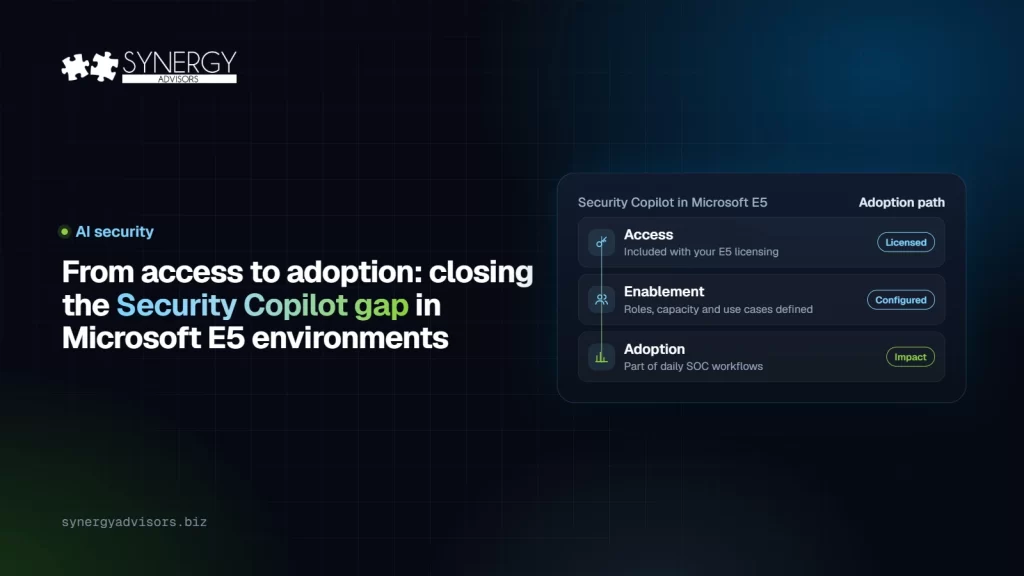
All organizations with E5 licensing already have Security Copilot. Very few are using it in a way that significantly impacts their security operations. This post explains why — and how to close that gap.
Microsoft 365 E5 was already one of the most comprehensive security licensing packages available in the market before the announcement that Microsoft would add Security Copilot to the stack. Not as a future roadmap item. Not as an optional add-on. It is part of the license, it is available, and in most organizations, it is not being used to its potential.
This is not a technology problem. Security Copilot is a capable, well-integrated platform. The problem is operational — and it is more specific than it might appear.
Why activation is not the same as adoption
When a new security capability becomes available inside an existing license, many organizations focus on basic activation: confirm access, run a pilot, and assign someone to explore it. The box is checked. The capability is deployed. And then, gradually, it fades into the background — used occasionally by a few analysts, ignored by most, and never integrated into the actual rhythm of security operations.
This pattern is well-documented across cybersecurity. However, we see it especially pronounced with AI-powered tools, because those tools introduce a dependency most organizations are not prepared for: the quality of what they produce is directly tied to the quality of what they receive.
Security Copilot is an intelligence layer. It reasons over security data, correlates signals, and helps analysts move through investigations faster. But it can only do that well when it has structured access to the right data — and when it is embedded in a workflow where analysts know exactly when to use it, what to ask, and what to do with the output.
Without those conditions, Copilot produces outputs that analysts cannot fully trust, in situations where they are not sure it applies, with results they are not sure how to act on. Adoption stalls. Not because the tool failed — but because the operational conditions for success were never built.
Three gaps we see consistently
Across the Microsoft E5 customers we work with, the success of their Security Copilot adoption consistently comes down to three specific problems:
- Context gaps: Security Copilot does not have visibility into the full picture of the environment. Signals from Defender for Endpoint, Defender for Identity, and Entra are available — but they are not surfaced to Copilot in a structured, unified manner. Copilot reasons over a fragment of the environment and produces outputs that reflect that limitation.
- Workflow gaps: There is no defined point in the security operations process where Copilot is formally invoked. It is not part of the triage process. It is not embedded in the investigation workflow. It is an optional tool that analysts can use if they choose to — and most choose not to, because the workflow does not require it.
- Use case gaps: Teams understand conceptually what Copilot can do, but they have no mapped set of high-value scenarios where it delivers consistent, reliable results in their specific environment. Without that map, every Copilot interaction is an experiment. Experiments do not drive adoption.
How to Security Copilot
At Synergy Advisors, we work with organizations to move Security Copilot from a licensed capability to an operational one — integrated into how security operations actually run, not sitting alongside it as an optional layer.
In practice, this means three things:
- Signal integration. We connect Security Copilot to the data sources it needs to produce reliable, actionable outputs in your environment. Defender XDR across workloads, Entra identity signals, M365 activity — the full operational context, structured and accessible, so that when Copilot is invoked it works with a complete picture, not a partial one.
- Workflow definition. We map the specific moments in your triage and investigation process where Copilot should be used — what triggers it, what questions it should be asked at each stage, and what format its outputs should take so analysts can act on them immediately. This removes the ambiguity that keeps adoption from becoming habit. We use your specific use cases, informed by our best practices and real-world experience, to build workflows unique to your requirements and operations.
- Use case activation. We identify the scenarios where Copilot delivers the highest operational value in your environment — incident summarization, lateral movement analysis, triage acceleration, alert contextualization — and build those into repeatable processes your team follows as part of normal operations.
The result is not a team that has been trained on Security Copilot. It is a team that uses Security Copilot because it is part of how the work gets done — and because it consistently makes that work faster and more accurate.
The deeper dependency: what Copilot needs to work at scale
As organizations go through this work, they consistently discover something that predates the Copilot adoption challenge: the operational environment that Copilot depends on is not yet structured to support it at scale.
Security Copilot requires clean, prioritized, well-organized operational context to produce outputs that analysts can trust. If incidents are handled inconsistently, if alert volume is unmanaged, if analyst workload is unevenly distributed with no visibility — Copilot surfaces those problems back to you rather than helping you work above them.
Fully closing the adoption gap means not just connecting Copilot to the right signals, but building the operational layer that structures how those signals are managed, prioritized, and acted on across the team. That layer is what separates organizations where Copilot is genuinely embedded in security operations from organizations where it is technically available but functionally peripheral.
It is also the foundation on which AI agents — the next evolution beyond Copilot — need to be built.
That operational layer is exactly what we cover in our next blog, The Operational Layer That Makes Security Copilot and AI Agents Work.

Ready to close the gap between access and value?
If Security Copilot is part of your E5 license and it is not yet part of how your security operations runs, that gap has a cost — in unrealized value, in slower investigations, and in a weaker foundation for what comes next.
At Synergy Advisors, we work with a select number of organizations at a time to make these engagements substantive. We do not run generic Copilot workshops. We build the integration, the workflows, and the use cases that turn Copilot into a real operational tool — specific to your environment, your team, and your threat landscape: [email protected]