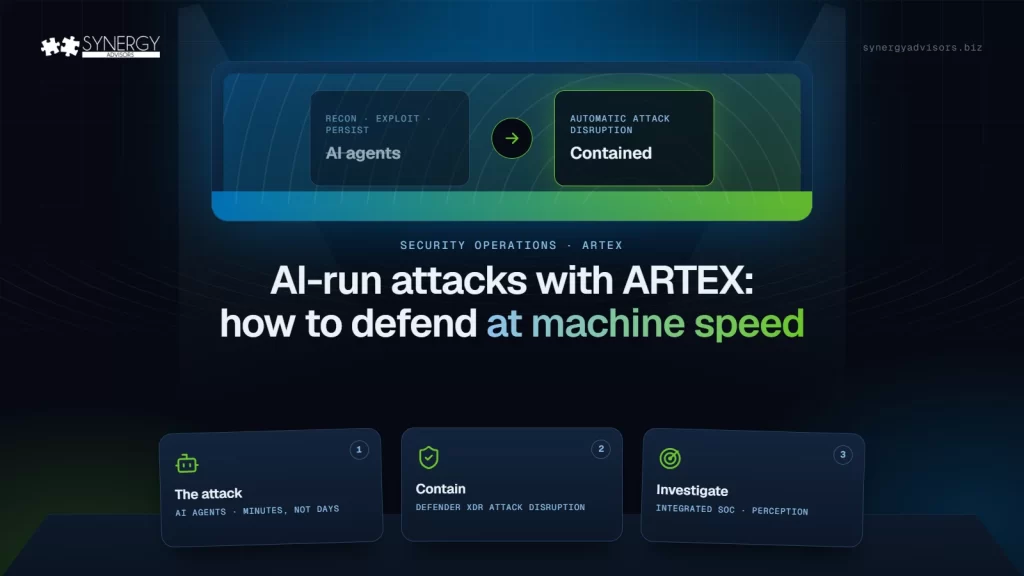

ARTEX is an AI-driven penetration testing platform that threat actors now use to run intrusions end to end: AI agents plan the attack, run standard tools and try another route when one fails. Microsoft says the agents can move from reconnaissance to persistent, privileged access “in a matter of minutes.” After an FBI alert on November 13, Microsoft Threat Intelligence and the Cloud Security Alliance both published guidance on November 25. ARTEX does not bring new attack techniques. It runs known ones at machine speed and at almost no cost, which changes what your defenses must do. This article explains how the attack works, what the organizations already hit said held up, and how Microsoft Defender XDR, the integrated SOC in Defender and Microsoft Perception map to each stage.
In October, we wrote about the Storm-0940 campaign and what AI-driven attacks meant for a Microsoft 365 tenant. Microsoft now names Storm-0940 among the actors using ARTEX. One Storm-0940 campaign that used it generated more than 151,000 failed sign-ins, peaking at 2,900 failures per minute. That is the shift in one number: the volume no longer depends on how many people the attacker has.
What ARTEX is, and who is using it
According to Microsoft Threat Intelligence, ARTEX was published as open source on GitHub in July 2026, with a Chinese-language interface. The original developer removed the source in October, forks continue to circulate, and in November the China-based company ThreatBook claimed ownership and began offering a commercial “ARTEX Pro”. It was built as a web application penetration testing tool, and that is how it works in attacks:
- A team of agents, not a script. A planner agent breaks the objective into tasks, worker agents run them with a real shell, and a reporter agent records the results, while a knowledge graph keeps track of the assets found.
- Any model, including unrestricted ones. The operator can connect any large language model, including models with their safety guardrails removed, and the framework can switch to another model when one fails.
- Standard tools. It uses the same tools defenders know, such as nmap, sqlmap, hydra, nuclei and Metasploit, which is why Microsoft stresses that it introduces no new techniques.
- No effort to hide, by default. Microsoft notes that ARTEX does not obfuscate its activity by default and uses recognizable default user agents. The CSA adds that the reconnaissance is noisy and easy to detect.
Microsoft has seen both state-sponsored and financially motivated actors use it: Storm-0940, Storm-3358, Onyx Sleet, Pearl Sleet, Crystal Typhoon and Salt Typhoon. As reported by the CSA, SentinelOne counts at least five actors and clusters using ARTEX since late August, and Check Point Research tracked three cybercrime campaigns that ran on inexpensive AI models. In those three campaigns, the estimated cost of the AI models alone ranged from $145 to $1,500. The FBI saw some of these intrusions reach privileged access in under three hours. The practical consequence, in the CSA’s words: organizations that were once too small to be worth an attacker’s time are now in range.
The attack chain, and the control that breaks each stage
ARTEX follows a classic intrusion path, which is good news: every stage has a control that already exists. The table maps the capabilities Microsoft observed to the protections Microsoft recommends in its report.
| Stage | What ARTEX does (Microsoft Threat Intelligence) | Controls that break it |
|---|---|---|
| 1. Reconnaissance | Port and service scanning, DNS enumeration, HTTP probing; crawls JavaScript bundles, source maps and API documentation; enumerates REST and WebSocket endpoints | Microsoft Defender External Attack Surface Management to find exposed assets, then Defender Vulnerability Management to fix them; attack paths in Microsoft Security Exposure Management; the Microsoft Perception Recon Agent to map attack paths |
| 2. Initial access | Exploits known vulnerabilities, bypasses authentication (unsigned tokens, manipulated OAuth callbacks), SQL injection, template injection, XXE, file upload flaws; password spraying and brute force | Web application firewall in prevention mode after tuning, rate limiting and bot protection (Application Gateway, Azure Front Door); Conditional Access with MFA for all users and phishing-resistant MFA for administrators; block legacy authentication; Entra ID Protection risk policies; Entra Password Protection and smart lockout |
| 3. Persistence and secrets | Uploads web shells; reads secrets from configuration files, .env files and private keys; dumps databases; Kerberoasting | Microsoft Defender for Endpoint on every internet-facing server, including Linux, with tamper protection and EDR in block mode; the attack surface reduction rule that blocks web shell creation on servers; secret scanning and push protection; managed identities instead of stored secrets |
| 4. Cloud identity abuse | Uses stolen credentials, maps cloud permissions, runs Microsoft Graph reconnaissance, adds application credentials, assigns privileged roles, reads keys and tokens from secret stores | Application management policies; Conditional Access for workload identities; workload identity risk detections for leaked credentials and suspicious sign-ins |
| 5. Lateral movement | Reuses credentials to move between systems | Automatic attack disruption in Microsoft Defender XDR to contain affected devices and users during the attack (automatic device isolation is in preview); blast radius analysis on the incident graph in the integrated SOC |
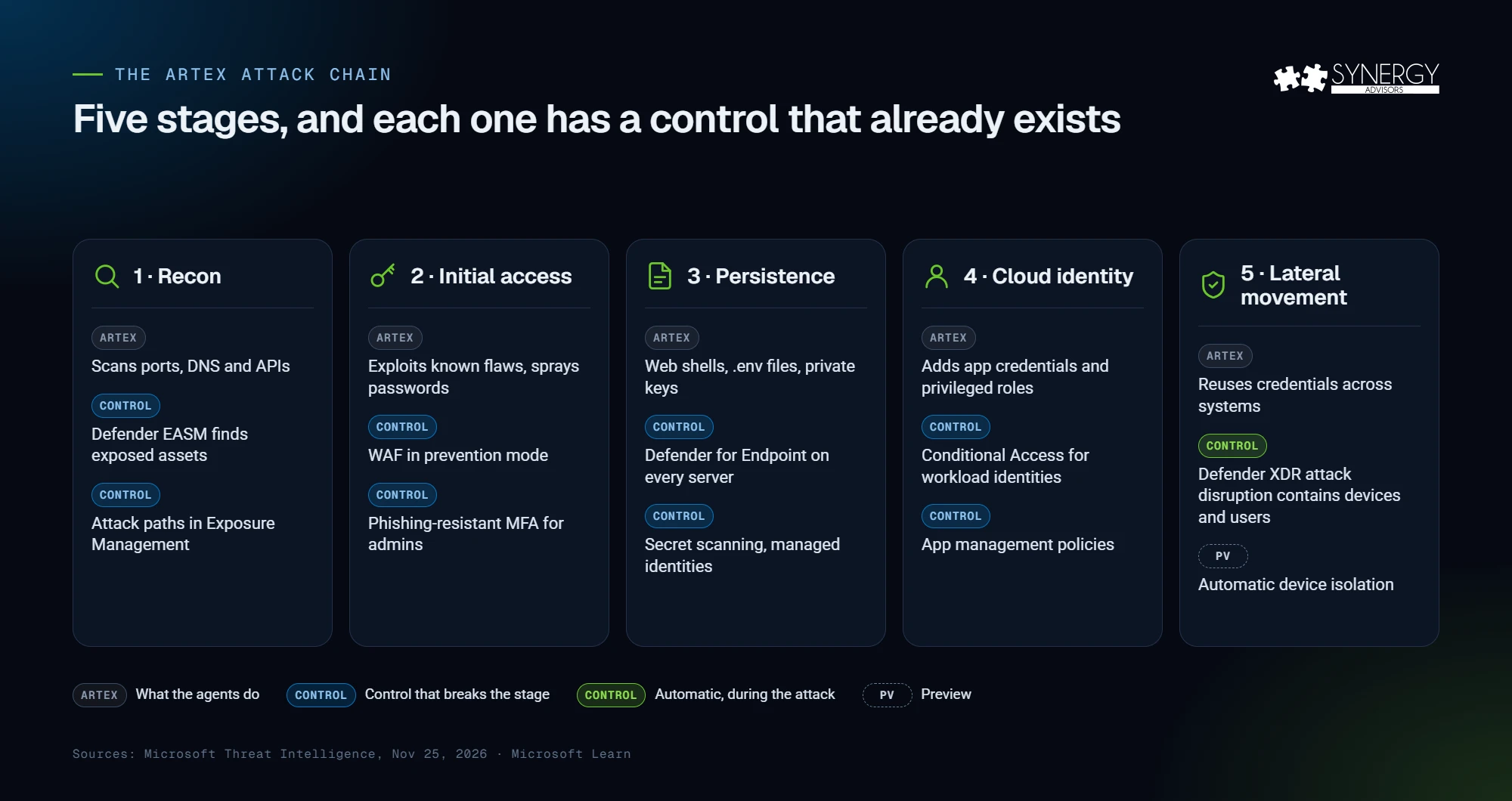
Microsoft adds two signals that matter for ARTEX specifically. Entra ID Protection raises a high-risk “Verified threat actor IP” detection when a sign-in comes from infrastructure tied to a known actor. And because the defaults are not obfuscated, Microsoft’s report includes detections and hunting queries for Defender and Microsoft Sentinel that your SOC can run today. We link the full report instead of copying them, because they will keep changing.
What the organizations already hit said worked, and what did not
On November 17, more than 800 CISOs joined an emergency briefing organized by the CSA. Some of their organizations had already been compromised. The paper that came out of it, “The Third Wave: ARTEX and Agentic Offensive Frameworks”, is the first in its series that reports results against real adversaries. Four patterns stand out:
- Everything at once. Activity appeared on separate attack surfaces in the same minute, lateral movement ran along several paths at the same time, and one exercise set off more than 500 alerts in 24 hours. Response teams built to handle one incident at a time were overwhelmed.
- They come back. Organizations that cleaned up only part of an intrusion were compromised again within hours, and some frameworks recreated accounts as soon as they were deleted. Eviction has to be complete.
- They target the defender’s AI. Operators planted markers telling a defender’s AI triage that the activity was an authorized test. Your own security agents need guardrails too.
- What held up: deception, because decoy credentials slowed or stopped a team of attacking agents; AI agents on the defender’s side, since teams that used them said they kept pace; and the basics, because the attacks rely mostly on known techniques.
- A pause at the perimeter. One responder changed the responses at the network edge to tell the attacker’s AI model that the activity was unauthorized, and reported a pause of about 18 hours. The CSA attributes that pause to the change in edge responses, not to the decoy credentials.
The paper’s hardest request is for boards: per-action human approval cannot keep pace, so executive leadership should give the CISO pre-approved authority to isolate, contain or shut down compromised production systems, with a person still deciding wherever a physical process is involved.
Why ARTEX outpaces a traditional SOC, and the Microsoft answer to each advantage
Blocking ARTEX at every stage is the goal, but the CSA briefing shows that new techniques are not the problem. What overwhelms a SOC that works at human pace are five advantages the attacker now has. The Microsoft security stack answers each one with a specific capability, and the logic matters more than the product list.
| ARTEX advantage | What it means for your SOC | Microsoft answer |
|---|---|---|
| Speed: from recon to privileged access in minutes | By the time an analyst opens the incident, the attacker already has an account or a device | Defender XDR automatic attack disruption contains devices and accounts during the attack |
| Volume: many surfaces at once, hundreds of alerts a day | One campaign looks like dozens of unrelated alerts in different tools | The integrated SOC in Defender correlates them into one incident; the Microsoft Perception Triage and Attack Investigation agents work the queue |
| Persistence: it comes back through a second door | A partial cleanup is reversed within hours | Investigation across endpoints, identities, email, Active Directory and cloud before closing; account disablement and session revocation |
| Web applications first | The most exposed code is the first target | Microsoft Perception web application playbooks to test and protect apps, fed by codename MDASH code scanning |
| It targets your AI | Planted markers tell defender AI the activity is an authorized test | Perception keeps humans approving critical actions; deception treats every touch of a decoy as hostile |
1. Speed: Microsoft Defender XDR automatic attack disruption. This is the CSA’s “pre-approved containment” already built into the product. According to Microsoft Learn, Defender XDR correlates signals from endpoints, identities, email and collaboration tools and SaaS apps into one incident, identifies the assets the attacker controls and contains them, acting at the incident level rather than on a single indicator. Microsoft states that for containment actions it keeps a confidence level of 99% or higher, based on real production data. It helps to separate what it automates today from what is still in preview:
- Automated today: containing a device or an IP address, and containing a user across onboarded devices (Defender for Endpoint); disabling a user in Active Directory, through domain controllers that run the Defender for Identity sensor, or in Microsoft Entra ID; revoking sessions and suspending the user in Entra ID; and acting on compromised OAuth apps (Defender for Cloud Apps). Microsoft lists Active Directory and Microsoft Entra ID support as generally available.
- Still in preview: automatic device isolation, which applies only to onboarded end-user workstations and is undone automatically after a set time window; and actions on accounts outside Microsoft, such as suspending a user in Okta or attaching a deny policy to an AWS IAM user, which run through Microsoft Sentinel connectors.
Every automatic action is added to the incident and the Action center, and your team can undo it. Microsoft explicitly recommends enabling attack disruption against ARTEX. Two decisions are yours: which critical users, devices and IP addresses to exclude, and making sure every device is onboarded to Defender for Endpoint, because device and user containment apply only to onboarded devices.
2. Volume: the integrated SOC in Defender, with agents working the queue. The core capabilities of the integrated security operations center (ISOC) are generally available, and Microsoft Sentinel moves into the Defender portal by March 31, 2027 (see our article on the move). When a framework fires hundreds of alerts across surfaces, correlating them into one incident, with Sentinel data and Defender XDR signals in the same place and the blast radius visible on the incident graph, is what keeps a team from chasing each alert separately. Microsoft Perception, generally available since Ignite, adds the agents: Microsoft says its Triage Agent can handle about 80% of the alerts in a typical Defender queue, based on its own analysis, and its Attack Investigation Agent reasons across endpoints, identities, email, Active Directory and cloud resources. Playbooks can start automatically from triggers, or from SIEM, SOAR and ITSM tools through APIs and the Model Context Protocol (MCP).
3. Persistence: complete eviction before closing the incident. The CSA participants who cleaned up only part of an intrusion were compromised again within hours. The same capabilities above serve the cleanup: an investigation that covers every surface the attacker touched, disabling the accounts it created or used, revoking sessions, rotating any secret it read and removing web shells, before the incident is closed.
4. Web applications: test them with agents before the attacker does. ARTEX is, at its core, a web application penetration testing tool. The CSA’s first recommendation is to test your own environment with the same kind of tools attackers use. At Ignite, Microsoft Perception added web application playbooks (“Run web pen test” and “Protect web app”) with red team agents that look for and validate paths to compromise, within the testing boundaries you set. Those playbooks can take code findings from codename MDASH, Microsoft’s multi-model agentic scanning harness: more than 100 specialized AI agents that find, debate and prove exploitable bugs in source code. Microsoft reported that MDASH found 16 vulnerabilities fixed in a single Patch Tuesday, four of them critical, and scored 88.45% on the public CyberGym benchmark. At Ignite, Microsoft said teams can run it from the Defender portal, the command line and CI/CD pipelines such as GitHub Actions and Azure DevOps, and review the generated fixes as pull requests. MDASH does not detect or block attacks in your environment; it removes the exploitable flaws ARTEX would use. In May it was in a limited private preview, and Microsoft has not yet announced general availability, so check availability for your tenant before you plan on it. The Web App Pen Test and Risk Reduction agents are still in preview.
5. Attacks on your AI: keep humans on the critical decisions. Microsoft Perception is designed so that security teams set priorities and approve critical actions, and detection rules written by its agents are reviewed before deployment. That matters when an attacker plants text telling your AI that its activity is an authorized test: an agent can triage at machine speed, but authorization should never come from inside the data it is analyzing. Deception closes the loop, because a decoy account or canary key has no legitimate use, so any touch is hostile regardless of what the traffic claims. Microsoft points to decoys and honeytokens in Microsoft Sentinel for this.
| CSA priority | Where Microsoft security fits | Status |
|---|---|---|
| Shrink the attack surface and test it | Defender External Attack Surface Management, Security Exposure Management attack paths, Perception web application playbooks | Perception generally available since November 17, 2026; Web App Pen Test agent in preview |
| Put AI agents into security work, and secure them | Microsoft Perception red, blue and green team agents, with human approval for critical actions | Generally available |
| Pre-approved containment at machine speed | Defender XDR automatic attack disruption | Available; Microsoft recommends enabling it. Active Directory and Entra ID actions generally available; automatic device isolation, Okta and AWS in preview |
| See the whole campaign | Integrated SOC in Defender (Defender XDR + Microsoft Sentinel) | Core capabilities generally available |
| Deploy deception | Decoy accounts and honeytokens, including in Microsoft Sentinel | Treat every activation as urgent |
| Fewer exploitable flaws in your code | Codename MDASH, from the Defender portal, the command line and CI/CD | Limited private preview in May; general availability not yet announced |
What to do this week
- Turn on automatic attack disruption in Microsoft Defender XDR, and confirm that Defender for Endpoint covers every internet-facing server, including Linux, with tamper protection on.
- Find what is exposed. Run an external attack surface discovery, take forgotten systems off the internet, and lock down the entry points of your three most critical applications.
- Hunt for exposed secrets. Scan code repositories and servers for keys and connection strings, then revoke and replace anything you find. Move applications to managed identities where you can.
- Close the identity doors. Require MFA through Conditional Access for every user, phishing-resistant MFA for administrators, block legacy authentication and turn on Entra ID Protection risk policies, including for workload identities.
- Plant deception. Add a decoy administrator account and canary keys, and treat every activation as an incident.
- Agree on the rules with leadership. Define what your SOC and its agents can contain without waiting for approval, and make sure every cleanup is complete, because partial evictions were reversed within hours.
How our experts help
- Our Managed Services run a 24x7x365 SOC with MXDR on Microsoft Defender XDR and Microsoft Sentinel. Our experts tune automatic attack disruption and its exclusions, connect the signals ARTEX leaves across endpoints, identities and cloud, and carry each incident through to complete eviction.
- The Micro-Vigilant SecOps Agent gives SOC managers a live view of how incidents are being handled, from workload to aging incidents, which matters most when alert volume spikes in a single day.
- Readiness for the integrated SOC and Microsoft Perception. Our experts plan the move of Microsoft Sentinel to the Defender portal and help you put Perception agents to work with the right approvals, as we explained in our Ignite summary for security leaders.
Frequently asked questions
What is ARTEX?
An AI-driven penetration testing platform, released as open source in July 2026, that coordinates several AI agents to run reconnaissance, web exploitation and credential attacks. Threat actors now use it to run intrusions end to end.
Is ARTEX a new kind of attack?
No. Microsoft says it introduces no new attack techniques and uses common penetration testing tools. What changed is speed, scale and cost: a downloadable framework and inexpensive models can now do work that used to require a skilled team.
Does Microsoft Defender protect against ARTEX?
Microsoft says it disrupts and contains ARTEX-enabled attacks across the Microsoft Defender suite, and recommends enabling automatic attack disruption in Defender XDR. Its November 25 report also includes detections and hunting queries for Defender and Microsoft Sentinel.
What is MDASH, and can I use it?
Codename MDASH is Microsoft’s multi-model agentic scanning harness for finding exploitable vulnerabilities in source code. At Ignite, Microsoft said it runs from the Defender portal, the command line and CI/CD pipelines, and can feed the Microsoft Perception web application playbooks. It was in a limited private preview in May, and general availability has not been announced. It does not detect attacks in your environment.
What should a security leader do first?
Turn on automatic attack disruption, find and remove exposed assets and secrets, require phishing-resistant MFA for administrators, deploy deception, and agree with leadership on what can be contained automatically.
Next step
Synergy Advisors experts can review your exposure to agent-run attacks and set up machine-speed containment across Microsoft Defender XDR and Microsoft Sentinel. Talk to our experts or join the Protect the Agentic Enterprise webinar on Tuesday, December 15, at 2:00 p.m. ET.
Sources
- What defenders need to know about ARTEX, the agentic AI framework threat actors abuse Microsoft Threat Intelligence, Microsoft Security Blog, November 25, 2026
- After FBI Alert on ARTEX, CISOs Report What Worked Against AI-Run Attacks: Cloud Security Alliance CISO Community Releases The Third Wave Cloud Security Alliance, November 25, 2026
- The Third Wave: ARTEX and Agentic Offensive Frameworks Cloud Security Alliance, November 2026
- Automatic attack disruption in Microsoft Defender Microsoft Learn
- What’s new with Microsoft Perception at Ignite 2026 Microsoft Tech Community, November 17, 2026
- Defense at AI speed: Microsoft’s new multi-model agentic security system tops leading industry benchmark (Taesoo Kim) Microsoft Security Blog, May 12, 2026